DoE Level VI and EU Ecodesign Efficiency Rules for Power Supplies
Written by engineers at the Daxpoo factory, Shenzhen · · 4 min read
Every external power supply sold in the US and the EU has to meet minimum efficiency rules. Most buyers know the “VI” on the label means something, but not exactly what. This guide explains the two main efficiency regimes, how they are measured and what to ask your supplier so your stock does not get stopped at customs or delisted from a marketplace.
Why efficiency rules exist
An adapter wastes energy in two ways: as heat while it is charging a device (active efficiency), and while it is plugged in with nothing connected (no-load power). Across hundreds of millions of adapters that waste adds up. Regulators therefore set a minimum average efficiency and a maximum no-load consumption, both depending on the adapter’s rated power.
United States: DoE Level VI
The US Department of Energy standard known as Level VI has applied to external power supplies since 10 February 2016. It replaced the older Level V requirements and tightened both measures:
- No-load power: for basic-voltage adapters up to 49W, the limit is 0.100W, down from 0.3W under Level V.
- Average active efficiency: measured at 25%, 50%, 75% and 100% of rated load, then averaged. The required value rises with the adapter’s rated power.
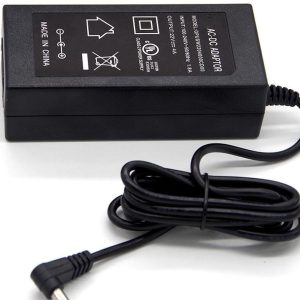
Compliant adapters carry the Roman numeral VI in the efficiency marking on the label.
European Union: Regulation (EU) 2019/1782
In the EU, efficiency is set by Commission Regulation (EU) 2019/1782, which has applied since 1 April 2020 and replaced the older Regulation (EC) 278/2009. It covers external power supplies up to 250W intended for household and office equipment. Battery chargers without a power supply function, uninterruptible power supplies, voltage converters and power supplies for medical devices are excluded.
The EU limits are broadly aligned with DoE Level VI and are often referred to by the older name “CoC Tier 2”. The European Commission has announced that this regulation will be replaced by Regulation (EU) 2025/2052 from 1 January 2028, so expect requirements to change again.
How efficiency is tested
A test lab measures input and output power at four load points and at no load, at both 115V and 230V input. The report should show:
- Efficiency at 25%, 50%, 75% and 100% load, and the average
- Efficiency at 10% load where required by EU rules for some products
- No-load power
- The applicable limit and a pass or fail result
What to ask your supplier
- An efficiency test report for the exact model and rating, showing both DoE and EU results.
- Confirmation that the label shows the correct efficiency marking.
- Assurance that key components will not change without re-testing. A cheaper transformer or controller IC can push a design out of compliance.
Reading the efficiency marking on a label
The international efficiency marking protocol uses Roman numerals inside a box on the adapter label. “VI” is the current level for the US market. If the label shows “V” or lower, the adapter does not meet current US requirements for new units, regardless of what the seller says.
In the EU, the label does not use a separate efficiency logo, but the ecodesign regulation requires manufacturers to publish efficiency and no-load values in the product information or technical documentation.
Products that are out of scope
Not every power product falls under these rules. In the EU, Regulation 2019/1782 excludes, among others:
- Battery chargers without a power supply function
- Uninterruptible power supplies
- Voltage converters
- Halogen lighting converters
- External power supplies for medical devices
The US rules have their own definitions and exemptions. If you sell a product that sits at the edge, such as a charger that also powers a device, get a lab opinion before assuming it is exempt.
Why efficiency affects reliability
An adapter that is 88% efficient at 65W turns about 9W into heat. One at 82% efficiency turns about 14W into heat. That extra heat sits in a small sealed plastic case, raising the temperature of capacitors and semiconductors. Electrolytic capacitor life roughly halves for every 10°C rise in operating temperature, so a cooler-running adapter typically lasts longer. Efficiency rules were written to save energy, but they also push the market toward more durable designs.
Preparing for the 2028 EU update
With the EU regulation due to be replaced from 1 January 2028, it is worth asking your supplier now whether their platforms already have margin against stricter limits. Designs that pass current rules with plenty of headroom are less likely to need rework.
Efficiency and quality go together
Meeting Level VI is not only about paperwork. Higher efficiency means less heat, and less heat means longer component life and fewer field failures. That is one reason we check output and protection on every unit and run a 24-hour burn-in before packing.
All our standard laptop chargers, USB-C chargers and LED power supplies are designed to current efficiency rules. For the full compliance picture, read our certification guide for importers, or ask us for the reports for any model through the quote form.
Frequently asked questions
What does the VI on a power adapter label mean?
It is the international efficiency marking for external power supplies. Level VI means the adapter meets the US Department of Energy standard that has applied since 10 February 2016.
What is the no-load limit under DoE Level VI?
For basic-voltage external power supplies rated at 49W or less, no-load consumption must not exceed 0.100W. Higher-power models have their own limits.
Which EU regulation sets power supply efficiency?
Commission Regulation (EU) 2019/1782, applied since 1 April 2020. The European Commission states it will be replaced by Regulation (EU) 2025/2052 from 1 January 2028.