How to Choose a Laptop Adapter Manufacturer in China: A Buyer’s Checklist
Written by engineers at the Daxpoo factory, Shenzhen · · 6 min read

Buying laptop adapters from China is easy. Buying ones that pass your customer’s incoming inspection, survive two years in the field and do not end up in a product recall is harder. Most of the difference comes down to who you buy from. This checklist is written from the factory side: these are the things we would check if we were sourcing from someone else.
1. Make sure you are talking to a manufacturer
A large share of suppliers on B2B platforms are trading companies. That is not automatically bad, but it adds a margin, slows down technical answers and makes quality problems harder to trace. A real laptop adapter manufacturer in China should be able to:
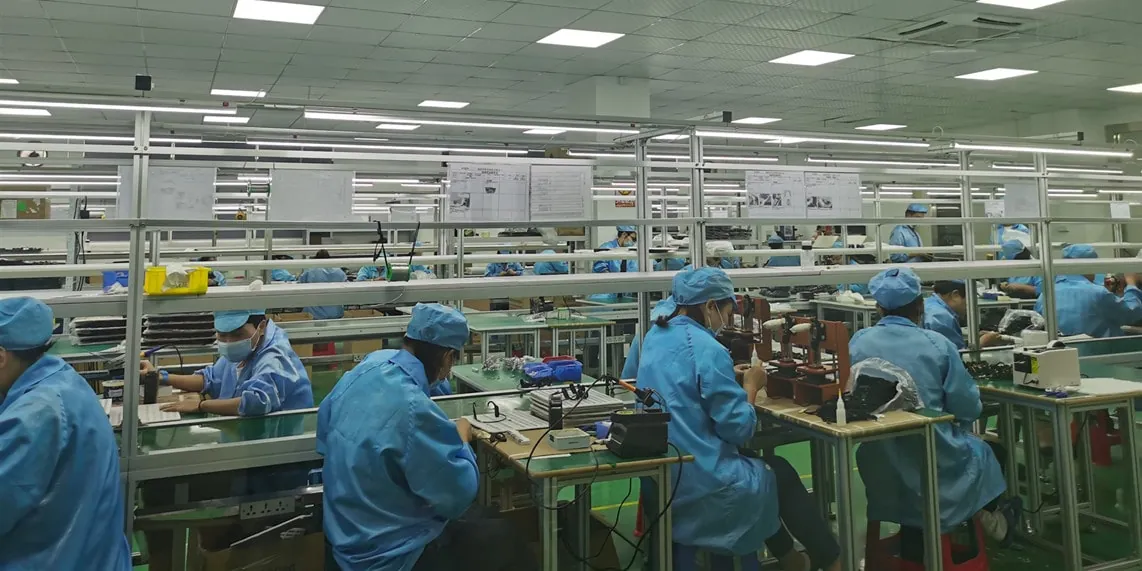
- Show a live video of its assembly lines, test stations and burn-in room, not a pre-recorded tour.
- Name the engineer responsible for your project and put you in direct contact.
- Provide test reports that list the factory’s own name and address as the manufacturer.
- Explain how a specific model is built: transformer, controller IC, enclosure material, cable gauge.
If every technical question takes two days and comes back in sales language, you are probably talking to a middleman.
2. Check the certifications for your market, not just the logo on the label
A CE mark printed on an adapter costs nothing. A valid test report behind it does. Ask for the actual reports and check that the model number, rating and manufacturer name match what you are buying.
- EU: CE under the Low Voltage and EMC Directives, RoHS, and the ecodesign efficiency rules for external power supplies.
- US: FCC Part 15 for emissions, a safety listing if your retail channel requires one, and DoE Level VI efficiency.
- UK: UKCA or CE, plus the correct BS 1363 plug if the adapter is wall-mounted.
We explain each of these in our certification guide for importers.
3. Ask how every unit is tested
Sampling is not enough for power supplies. The questions that separate good factories from average ones are:
- Is every unit tested for output voltage, ripple and protection functions, or only a sample?
- Is there a hi-pot (dielectric strength) test on the production line?
- Are finished units burned in under load, and for how long?
At our factory every adapter runs under load for 24 hours before packing. We wrote a separate article on why burn-in testing matters and what it catches.
4. Order samples the right way
Samples are only useful if they represent mass production. When you order them:
- Order from the exact model and version you will buy, with your plug type and cable length.
- Test them on the real devices your customers use, including older models.
- Measure output voltage at no load and full load, and check temperature after an hour at full load.
- Keep one sample sealed as a “golden sample” to compare against the first bulk shipment.
5. Understand MOQ, lead time and what drives the price
Price differences between factories usually come from components you cannot see: copper weight in the transformer, capacitor brand and temperature rating, cable gauge and the quality of the enclosure plastic. A quote that is 30% lower than the market rarely comes from efficiency alone.
For standard models with your logo, label and packaging, MOQs are usually modest. Fully custom designs carry tooling and certification costs and need a higher volume. Our OEM vs ODM guide explains which route fits which buyer.
6. Agree on quality control before the first order
Put these points in writing before you pay a deposit:
- Acceptable quality level (AQL) for the final inspection and who performs it.
- The documents that ship with every batch: test reports, inspection report, packing list.
- How defective units found in the field are handled and replaced.
- Warranty period, typically one year for replacement laptop adapters.
7. Visit, or at least audit, the factory
A one-hour video audit tells you more than weeks of emails. Ask to see incoming inspection, the assembly line, the test stations, the burn-in area and the warehouse. If you cannot travel, a third-party audit is a reasonable cost on a first order.
You can see how our own lines are organised on our factory page.
Red flags that should stop an order
Some warning signs are subtle, others are not. Any of these should make you pause before paying a deposit:
- One price for every quantity. Real factories price by volume because setup, packaging and testing costs are spread differently. A flat price usually means a trader buying from several workshops.
- Every model “in stock”. A factory with 4,000 models does not hold stock of all of them. Someone who claims to is often reselling.
- Certificates that are images, not reports. A JPEG of a CE “certificate” from an unknown body is not evidence. Ask for the full test report with photos and test data.
- No questions about your market. A good manufacturer asks where the adapters will be sold, because plug type, label and certification depend on it.
- Reluctance to put quality terms in writing. If AQL, warranty and replacement terms stay verbal, expect arguments later.
How to compare quotes fairly
Two quotes for “65W laptop adapter, 19.5V 3.33A” can describe very different products. Before you compare prices, line up the specifications:
| Item to compare | Why it changes the price |
|---|---|
| Efficiency level (DoE VI, EU ecodesign) | Higher efficiency needs better components |
| DC cable gauge and length | Thicker copper costs more but runs cooler |
| Capacitor brand and temperature rating | 105°C capacitors last longer than 85°C parts |
| Housing material | Flame-retardant PC costs more than recycled plastic |
| ID chip for HP and Dell tips | Required for the laptop to charge its battery |
| Burn-in time and test coverage | Rack space and labour |
| Packaging | Bulk bag versus retail box with inserts |
Ask each supplier to fill in the same table. The cheapest quote often becomes the most expensive once you account for returns.
Plan the relationship, not just the first order
The real value of a good manufacturer shows up on the fifth order, not the first. Ask how they handle component shortages, whether they notify you before changing a part, how quickly they can add a new model to your range, and whether they can hold safety stock for your fast movers. A supplier who thinks about these questions with you is worth more than a small price difference.
Quick checklist
- Factory, not trader, confirmed by live video
- Valid CE, FCC, RoHS and efficiency reports for your exact model
- 100% electrical test and burn-in on every unit
- Samples tested on real devices, golden sample kept
- AQL, documents and warranty agreed in writing
If you are comparing suppliers for replacement laptop chargers or USB-C and GaN chargers, send us your model list and target quantities through the quote form. We reply within one working day with factory pricing and lead time.
Frequently asked questions
How can I tell if a supplier is a real factory or a trading company?
Ask for a live video walk-through of the production line and burn-in room, a business licence that lists manufacturing in its scope, and test reports issued in the factory’s own name. Traders usually cannot show all three.
What MOQ should I expect for OEM laptop adapters?
For standard models with your label and packaging, many factories start at a few hundred pieces per model. Fully custom designs need higher volumes to cover tooling and certification.
Which documents should come with a laptop adapter shipment?
At minimum: the CE or FCC declaration and test reports, a RoHS report, the efficiency test result (DoE Level VI or EU equivalent), and the inspection report for the batch.